
CASE STUDY
OpenAI Ads Reporting in AdControl: A Better Weekly Review
Turn synchronized campaign data into a review with clear context, useful questions and a named next action. A practical routine for UK agencies and US teams.
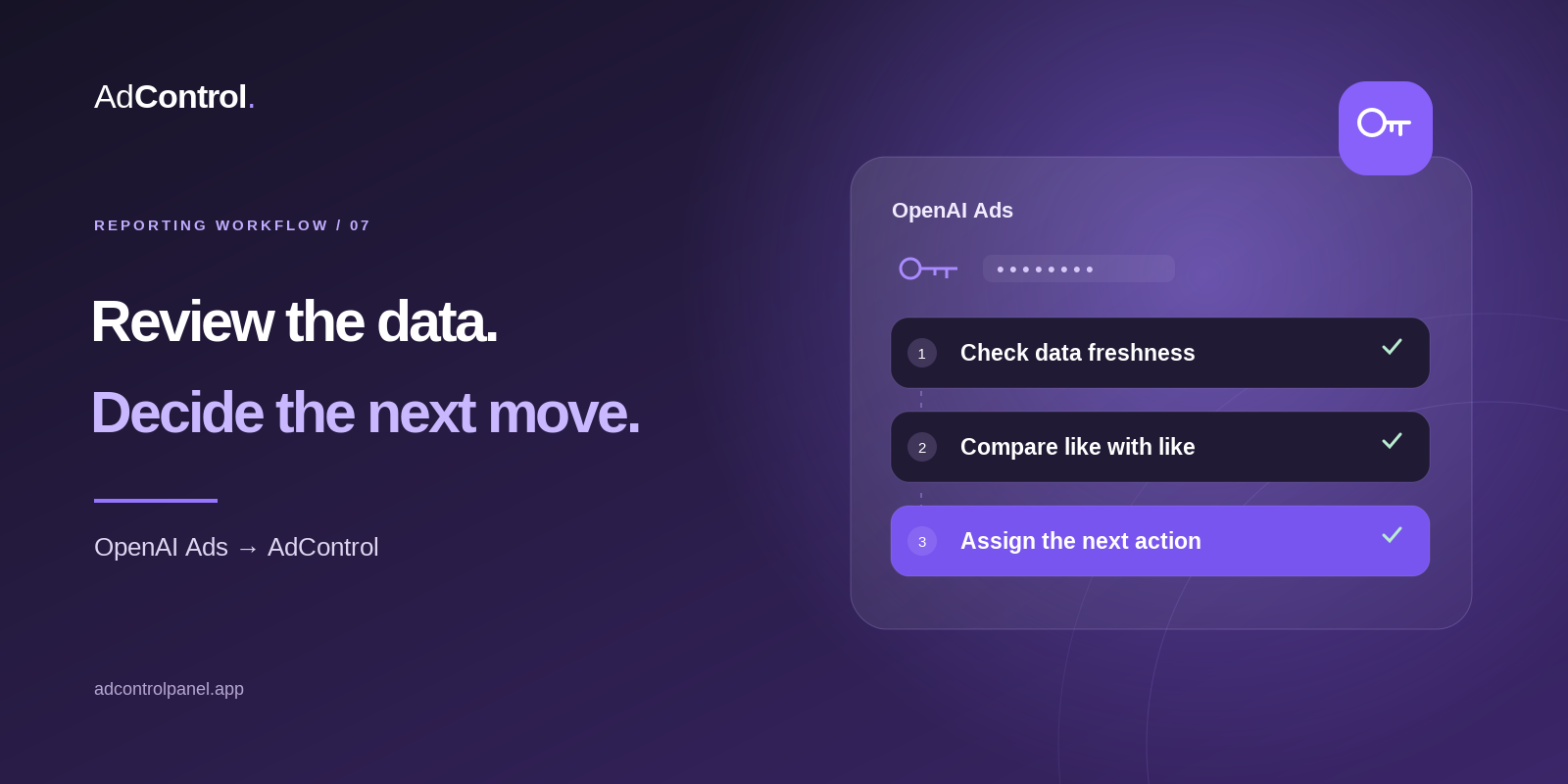
REPORTING WORKFLOW · 07
The purpose of a weekly campaign review is not to repeat the dashboard out loud. It is to decide what needs attention and what should happen next. An OpenAI Ads connection gives AdControl access to available campaign data; a useful reporting routine adds the context that makes those figures interpretable.
Start with the snapshot you actually have
After a successful connection, OpenAI Ads synchronization retrieves campaign resources and available insights for the selected workspace. Treat the imported data as a snapshot. Check when synchronization succeeded and whether a warning affected the view before discussing the latest movement.
For a UK agency operator, that means confirming the client account before preparing the meeting. For a US in-house lead, it means checking that the workspace represents the intended launch. Both teams benefit from distinguishing “we have stored data” from “the latest import completed successfully.”
Write down the reporting context once
Identify the account
Use the advertising account reference, workspace and reporting period. Confirm the account currency and timezone instead of inferring them from the team’s location.
Define the comparison
Use comparable date ranges and explain any change to campaign scope. A partial launch week should not be treated as equivalent to an established full week without context.
Check measurement
Confirm what a conversion means and whether revenue tracking is available. An absent or zero field is not enough on its own to diagnose an advertising result.
Use metrics to ask better questions
| Review area | Question to ask | Context to keep |
|---|---|---|
| Spend and delivery | Did the campaign run over the period we are reviewing? | Budget, schedule, account status and review state |
| Impressions and clicks | What changed in the available response data? | Comparable period, audience and creative |
| Conversions and revenue | Is the measurement setup understood and complete? | Event definition, tracking and attribution assumptions |
| Campaign state | Does the next action require a human decision? | Paused resources, outstanding checks and approval owner |
Bring AI analysis into the review without confusing the keys
Where the platform’s AI analysis is available, use its output as material to review alongside the campaign context. The current implementation uses the platform-configured DeepSeek provider, separately from the OpenAI Ads connection. The advertising credential supplies account access; it does not choose the analysis model.
Do not let an analysis summary replace the checks on data freshness, measurement or the intended campaign. A recommendation is most useful when the reviewer can trace the question, inspect the relevant context and decide whether the proposed next action is appropriate.
End with an action record, not another export
A useful review record names the issue, the supporting period, the action owner and what needs checking next. If the data is incomplete, the next action may be to fix synchronization or measurement. If the campaign is prepared but paused, it may be to complete a launch review.
For example, an agency account manager can hand the operator a specific question about the client’s latest import rather than a vague request to “check the numbers.” A growth lead can assign the follow-up review without claiming that an early result proves the whole campaign strategy. These are illustrative operating examples, not customer results.
Evaluate whether the meeting becomes more useful
Measure the preparation you repeat: collecting figures, locating the account, explaining the date range and correcting context. Compare the same task before and after adopting the routine. Keep these process measurements separate from changes in campaign performance.
The desired outcome is a review that starts with a trustworthy context and finishes with a specific next step. There is no automatic weekly reporting schedule or promised reduction in preparation time in this example. Establish your own baseline and record the result.
Choose the next operational playbook
A useful report makes the next decision clearer.
Connect the account, check the context and give the team a specific action to follow up.
More case studies
OpenAI Ads for US Teams: A Campaign Launch Review Checklist
Bring the brief, account checks and paused campaign review into one launch routine. A practical checklist for US growth teams preparing an OpenAI Ads test.
OpenAI Ads for UK Agencies: A Repeatable Client Handover
Organise account ownership, workspace access and reporting context before the next client review. A practical handover workflow for a UK agency team.
One API key. A clearer campaign workflow.
Connect OpenAI Ads to AdControl, bring campaign data into one workspace, and move from scattered checks to decisions you can review with confidence.